

Math through play · Ages 3 to 6
Math games for preschool and kindergarten: 12 playful ideas for home
Quick answer
The best math games for preschool and kindergarten are short, hands-on and full of real things to count: snacks, toys, steps. Aim for five to ten minutes of counting, comparing, adding, taking away and spotting patterns, with lots of praise for trying. A camera game like SillyCam's Math pack can add a silly, screen-based twist.
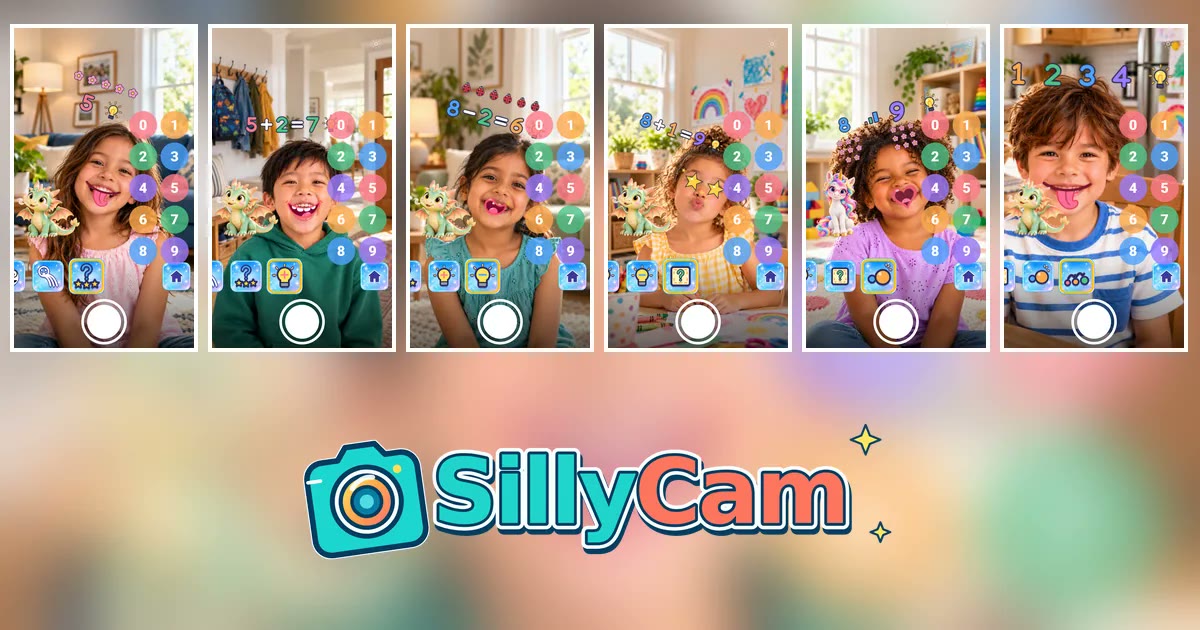
Young children learn math best when it feels like play: counting real things, noticing which pile is bigger, and laughing when a sum comes out right. The games below take five to ten minutes and need nothing more than what is already in your kitchen. A few use a phone, and those are marked.
What math do preschoolers and kindergartners learn?
Preschool and kindergarten math is mostly about number sense: knowing what numbers mean, not just how to say them. In the United States, the kindergarten standards focus on four things:
| Skill | What it looks like at home | Typical age |
|---|---|---|
| Counting | Touching each toy once while saying "one, two, three" | 3 to 5 |
| Comparing | "Who has more grapes, you or me?" | 4 to 5 |
| Adding and taking away | "You have two cars. Here's one more. How many now?" | 4 to 6 |
| Patterns and counting on | "Two, four, six... what comes next?" | 5 to 7 |
Every child moves at a different pace. These ages are a rough guide, not a checklist.
Free printable for grown-ups
Silly Math Games: a printable activity pack
Six pages of counting, adding, take-away and pattern puzzles with Dandelion and Sprout, one for each SillyCam math game. Print them for the kitchen table, a car trip or a rainy afternoon. No screen needed.
Which counting games work for 3- and 4-year-olds?
- Snack count. Put four crackers on a plate. Count them together, touching each one. Eat one. Count again.
- Stair steps. Count every step out loud on the way up, and count backwards on the way down.
- Hide and count. Hide three to six toys around a room. Your child finds them and counts how many are home.
- Silly Count (phone). In the SillyCam Math pack, stars or ladybugs drift around your child's head on the camera screen. Your child counts them and taps the number, and the things line up in a row when it's right.
How do I make adding and taking away fun?
Start with stories, not symbols. Children understand "three ducks, and one more duck swims over" long before they can read "3 + 1".
- Bath-time ducks. Float two ducks, add one, count the total. Then one swims away.
- The disappearing cookie. Line up five pieces of cereal, have your child close their eyes, and eat one. How many are left? How many did you eat?
- Silly Sums and Silly Takeaways (phone). A sum floats above your child's head. If they get stuck twice, counting dots appear under each number. In Silly Takeaways, things pop away in sparkles so your child sees what is left.
What about comparing numbers and patterns?
- Two-hand grab. Each of you grabs a handful of blocks. Line them up side by side. Whose line is longer?
- Clap patterns. Clap, clap, stomp. Clap, clap, stomp. What comes next? Let your child make up the next pattern.
- Which Is Bigger? (phone). Two numbers float over little piles of stars. Your child taps the bigger number, and it grows and bounces.
- Number line hop. Chalk the numbers 0 to 10 on the pavement. Call out "start at 3, hop 2" and count the landing spot together.
- Number Patterns (phone). Four numbers in a row with one missing:
1 2 ? 4. Later rounds count by twos and count down.
How do I keep math games short and positive?
- Stop while it's fun. Five happy minutes beats twenty restless ones.
- Praise the counting, not just the answer. "You touched every one!" builds the habit that leads to right answers.
- Let mistakes be silly. Wrong answers are part of the game. In the SillyCam games a wrong answer wobbles and puzzled question marks pop up. There is never a buzzer or a sad face.
- Count everywhere. Socks in the laundry, cars at a red light, birds on a wire. Math that shows up in daily life sticks.
Try it tonight
- At dinner, ask "How many peas are on your spoon?" Count them together.
- Add two more peas. "How many now?"
- Ask "Who has more, you or me?" and line up both piles to check.
- Celebrate the counting with a high five, whatever the answer.
Questions parents ask
How much math should a preschooler do each day?
There is no set amount. A few minutes of playful counting or comparing, folded into everyday moments like snack time or the walk to the car, is plenty for most three- and four-year-olds. Stop while it is still fun.
What math should my child know before kindergarten?
Many children starting kindergarten can say the numbers to 10, count a small group of objects by touching each one, and tell which of two groups has more. They will learn much more during the kindergarten year, so these are a starting point, not a test.
Are math apps good for preschoolers?
They can be, if the app is short, calm and free of ads, and if a grown-up joins in some of the time. Look for apps where a wrong answer leads to a hint rather than a buzzer, and where nothing pushes your child to keep tapping or buy things.
My child guesses instead of counting. What helps?
Slow the game down and count together, touching each item as you say the number. Smaller groups (three to five things) and a big celebration for careful counting, not just right answers, help children trust the counting rather than guess.
Free printable for grown-ups
Silly Math Games: a printable activity pack
Six pages of counting, adding, take-away and pattern puzzles with Dandelion and Sprout, one for each SillyCam math game. Print them for the kitchen table, a car trip or a rainy afternoon. No screen needed.